

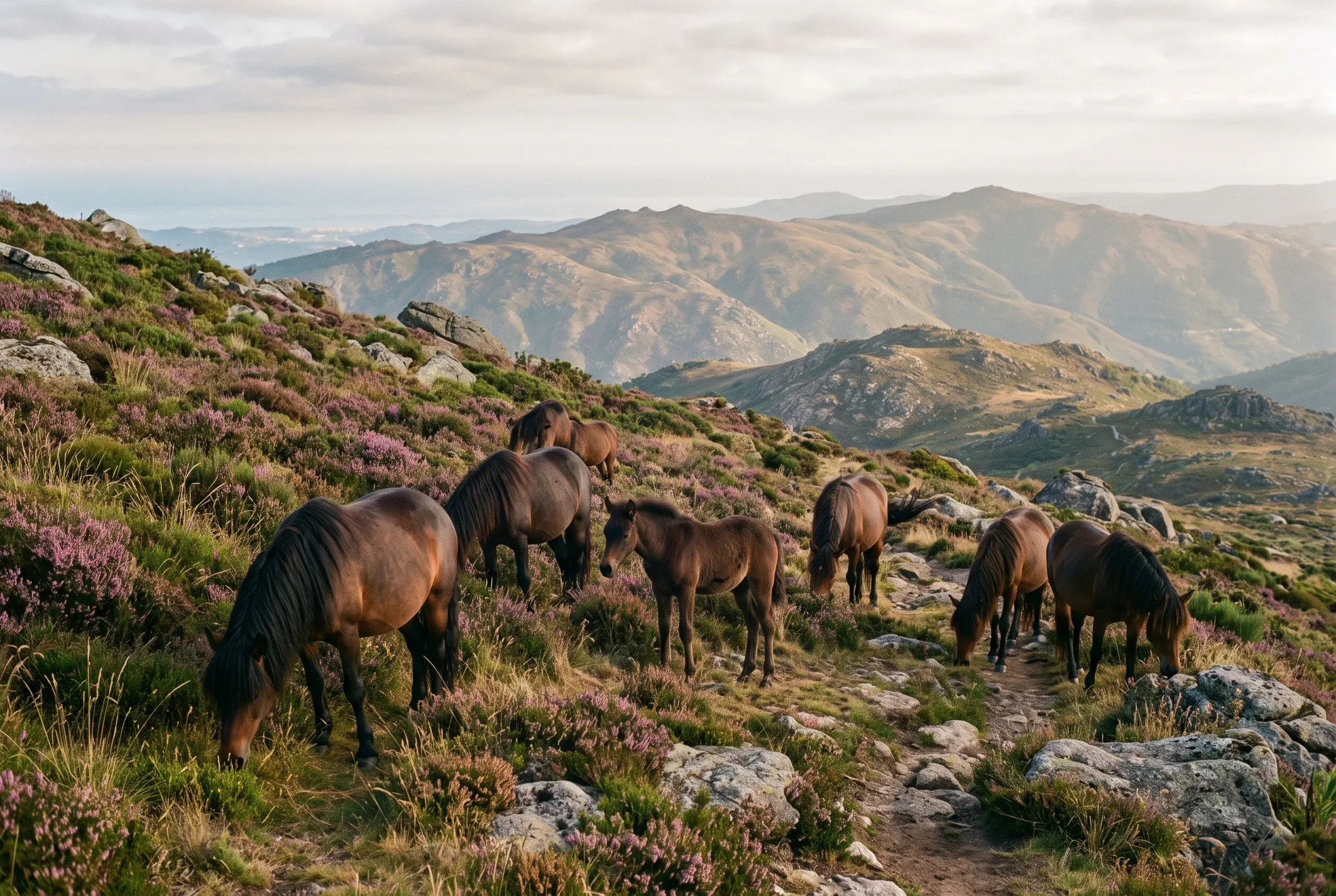
Most visitors come to Viana do Castelo for the surf at Praia do Cabedelo, the view from Monte de Santa Luzia or a glass of chilled vinho verde. Very few realise that less than half an hour inland, on the granite plateaux of Serra d’Arga, small herds of wild horses still roam exactly as they have for thousands of years.
They are called garranos — sturdy, pony-sized horses with thick dark manes and an unhurried way of watching you back. No fences, no stables, no riders. They are born on the mountain, raise their foals on the mountain, and face its winters, its wildfires and its wolves entirely on their own terms. Spain and Portugal’s Atlantic hills are among the last corners of Europe where a scene like this still exists.
At VIANAEQUESTRE we have spent every day since 2009 around horses, and a garrano sighting still stops us in our tracks. This is our local’s guide to the breed: where it comes from, how it survives alongside the Iberian wolf, why it matters — and how to see these wild horses of Portugal without disturbing them.
A horse older than history
The garrano did not arrive in northern Portugal; as far as anyone can tell, it was always here. Prehistoric rock engravings across north-west Iberia — most famously in the Côa Valley — depict small, compact horses with rounded profiles and heavy manes, and many researchers see in those ancient carvings a portrait of the garrano’s direct ancestor: an Atlantic mountain horse that grazed these hills long before Portugal existed as a country.
Cousin — or grandfather — of the Celtic ponies
Genetic studies point to a very old lineage, related to the pony breeds of Europe’s Atlantic fringe, and the garrano is widely considered the likely ancestor of the Galician pony just across the River Minho in Spain. The science is still being refined, but on one point there is broad agreement: this is a genuinely ancient, native breed, shaped by this exact landscape.
Garranos are easy to recognise once you know what to look for:
- Small and stocky — usually 1.20 to 1.35 metres at the withers
- Brown to almost black coat, with a thick mane and tail
- Sure-footed and tough, built for steep, wet, rocky ground
- Living in family bands — one stallion, a handful of mares and the year’s foals
For centuries these little horses powered rural life in the Minho, hauling firewood and grain and carrying families to markets and festivals. When tractors arrived, many garranos simply returned to the mountains they came from.
Wild and free on Serra d’Arga
Serra d’Arga rises to around 800 metres between Viana do Castelo, Caminha, Vila Nova de Cerveira and Ponte de Lima, and was classified as a Regional Protected Landscape in 2021. It is a strange, beautiful world of rounded granite boulders, wet meadows, small lagoons and old shepherds’ paths, with the remote chapel of São João d’Arga at its heart and the Atlantic glittering on the horizon.
Strictly speaking, most garranos are “semi-wild”: many have owners who check on them from a distance once or twice a year, but the animals live on the open mountain year-round, in natural bands, with no daily human contact. For the visitor, the distinction hardly matters — what you see is wild horse behaviour, unscripted.
And the herds do far more than decorate the view. By grazing gorse and broom, garranos keep the scrubland open, reduce the fuel that feeds summer wildfires and spread seeds across the hills. Ecologists like to call grazers ecosystem engineers; up here, they are simply the mountain’s gardeners.
Living with the Iberian wolf
You cannot tell the garrano’s story without the Iberian wolf. These north-western mountains have always been wolf country, and garrano foals are part of the wolves’ natural diet — regional studies suggest free-roaming horses are among the most important prey for the local packs.
It is a hard relationship, but an ancient and strangely balanced one. Wolf pressure has shaped the breed’s behaviour: bands stay tightly bonded, mares form protective circles around their foals, and youngsters learn early not to stray. Many conservationists argue the two species now depend on each other — where garranos graze, wolves find wild prey and take less livestock from the villages. Protecting one quietly protects the other.
Saving a living piece of heritage
The twentieth century was unkind to the garrano. Once farm machinery took over, the breed was no longer “needed”, and numbers collapsed. Serious recovery work only began in the 1990s, with an official studbook and organised efforts by breeders and local councils. Today the garrano is still classed as an endangered native breed, with a population in the low thousands.
The threats have not gone away — wildfires, the decline of traditional herding, cross-breeding and pressure on mountain habitats. But respectful tourism genuinely helps: every visitor who climbs the serra to watch wild horses, and follows the rules while doing so, adds weight to the argument that a garrano is worth more alive and free on the mountain than forgotten.
How to see the garranos — respectfully
On Serra d’Arga, your best chances are on the high plateaux, around the wet meadows and near São João d’Arga, early in the morning or late in the afternoon. Spring and early summer are ideal, when foals are at foot; in winter the bands move to more sheltered ground and the fog can swallow the whole mountain.
A few golden rules:
- Keep your distance — around 50 metres is a sensible minimum; bring binoculars or a zoom lens.
- Never feed the horses — it teaches them to approach people and can harm their health.
- Do not try to touch or pet them — they are wild animals, however calm they look.
- Keep dogs on a lead — a loose dog can scatter a band and separate a foal from its mother.
- Give mares with foals extra space — never position yourself between the two.
- Check the rules before flying a drone — this is a protected landscape with its own regulations; when in doubt, ask us before you go.
The best seat in the house: a saddle
There is a particularly memorable way to look for garranos — from horseback. Our Mountain Trail Ride leaves our stables in Areosa and climbs into the hills of Montedor, past centuries-old windmills, with Monte de Santa Luzia on one side and the blue outline of Serra d’Arga on the other. On the higher paths we spot garranos on most spring and summer outings — though they are free animals, so we never promise, we just keep our fingers crossed.
We ride in small groups of no more than 8, always with a certified guide, and riders of all levels are welcome. If you would like a full day deep in the Minho — mountains, villages and a glass of vinho verde included — have a look at our Premium Minho Experience, or browse all our experiences. Prices on request: message us on WhatsApp at +351 934 142 212 or through our contact page.
Frequently asked questions
Are the garranos dangerous?
They are not aggressive by nature, but they are wild, unpredictable animals — especially stallions and mares with foals. Watch from a distance, move calmly and never corner a horse. If you would rather explore with someone who knows the mountain and the herds, our guides are happy to help — just message us on WhatsApp at +351 934 142 212.
When is the best time of year to see wild horses in Portugal’s Serra d’Arga?
Spring to early summer is the sweet spot: the bands graze the open plateaux and the year’s foals stay close to the mares. Early morning and late afternoon are the most active hours. Winter sightings happen too, but rain and thick Atlantic fog make them far less reliable.
Do I need to ride a horse to see the garranos?
Not at all — Serra d’Arga has waymarked walking trails, and patient hikers are often rewarded. That said, seeing wild horses from the back of a calm, trail-wise horse is something else entirely, and our mountain rides suit complete beginners as well as experienced riders — just ask, and we will happily advise.