

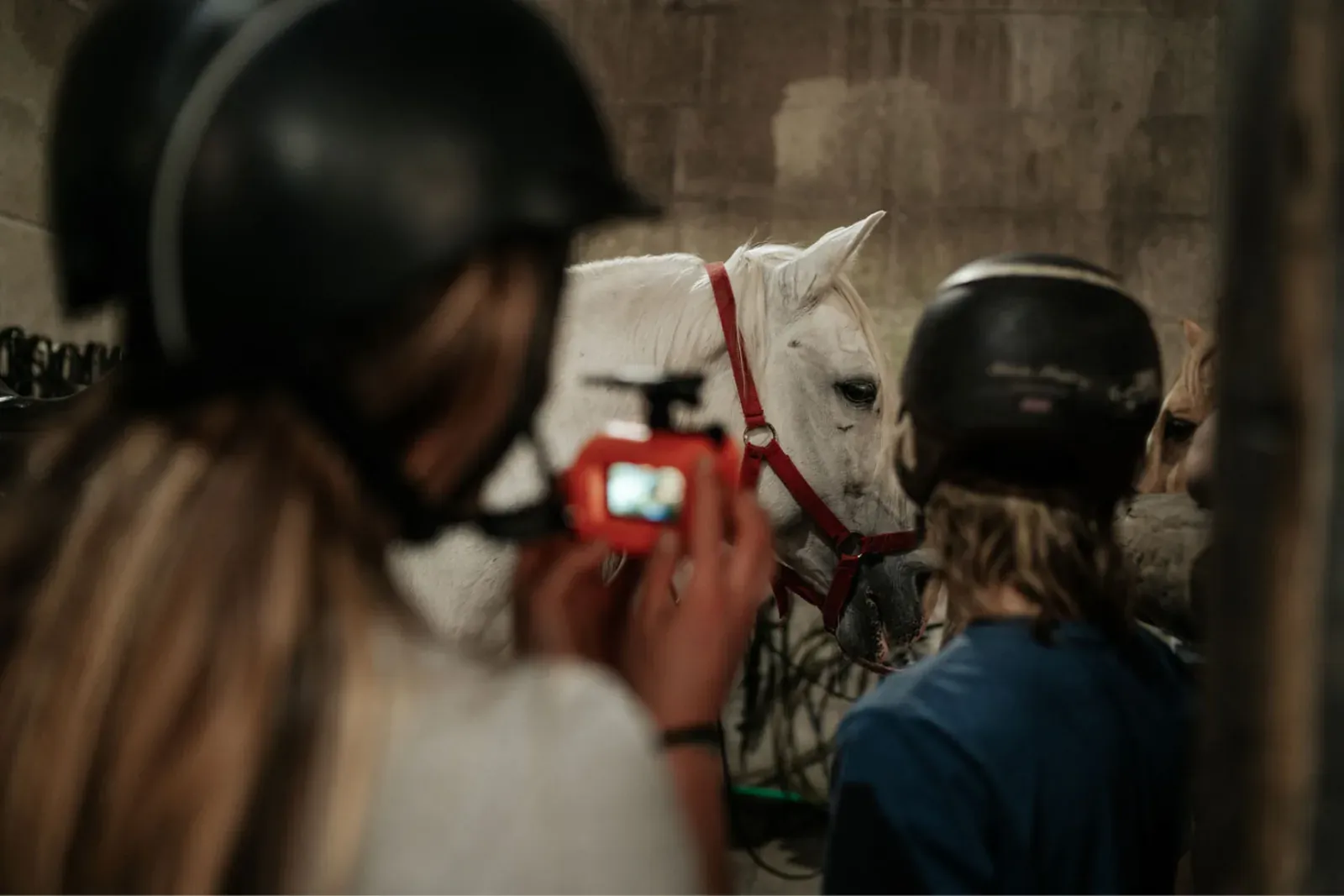
There is a question we hear almost every week at our stables in Areosa, usually from a parent with a child tugging at their sleeve, pointing at the horses: “How old does she have to be to start?” The short answer: younger than you probably think. The long answer is this article.
VIANAEQUESTRE, the equestrian association of Viana do Castelo, has been teaching children to ride since 2009. Most of our young riders are local, but every year more visiting families — here for the beaches and the views from Monte de Santa Luzia — decide a first encounter with a horse beats another afternoon by the pool. Some come back the next summer and ask for “their” pony by name.
Horse riding for kids is far more than a sport: it is a quiet education in posture, patience and responsibility, delivered by a four-legged teacher entirely immune to tantrums. This guide covers the right ages, the first lessons, safety, and why so many parents tell us they can see the difference at home.
What age can children start riding?
There is no single magic age, but at our association there are two clear doors in:
- First rides (“baptisms”) from age 4. A short, gentle introduction with the horse led on foot by an instructor at all times. The child feels the movement, strokes the animal and discovers horses are far friendlier than they look from the ground — no technique required.
- Proper riding lessons from age 6. Around this age, most children have the balance, core strength and attention span to genuinely start learning: holding the reins, giving aids, understanding the horse rather than just sitting on it.
Between 4 and 6, a child can repeat the introductory ride as often as they like — some do three or four before moving on to lessons. Every child has their own pace, and pushing a four-year-old into a formal lesson is the surest way to put them off horses altogether.
There is no upper limit either: we have beginners who start at 6, at 10, at 14 — and more than a few parents who, after weeks of watching from the fence, quietly book riding lessons of their own. Nobody resists for long.
What riding actually gives a child
Families usually come to us for the fun part: the child loves animals, spotted horses at a festival like the Romaria d’Agonia, and wants a go. They stay for the benefits.
Posture and physical confidence
Staying balanced on a moving animal constantly engages the core, back and legs — almost without the child noticing. After a few months the change is visible to the naked eye: straighter backs, better balance, sharper coordination. For a generation that spends hours hunched over screens, that alone is worth the trip.
Responsibility and routine
At VIANAEQUESTRE, a lesson does not begin when the child gets in the saddle. It begins earlier — brushing the horse, checking hooves, helping with the tack — and ends afterwards, caring for the animal. Children quickly grasp that the horse depends on them: it gets hungry, it gets tired, it likes being scratched behind the ears. No lecture comes close.
Empathy, taught by a horse
A horse never says a word, yet it communicates constantly — through its ears, its tail, its breathing. Children learn to read these signals and adjust their own behaviour: speak more softly, move more calmly, earn the animal’s trust rather than demand it. Parents tell us this sensitivity shows up later with siblings, classmates, even the family dog.
Fewer screens, more Atlantic air
Let’s be honest: half the families who contact us mainly want their children off the sofa. Riding is an unbeatable argument — no game competes with a real animal that recognises the child on arrival. And here in Areosa, between the ocean at Montedor and the hills rising towards the Serra d’Arga, the playground is outdoors all year round.
What the first lessons look like
A child’s first lesson with us always follows the same principle: confidence first, technique second.
- Meeting the horse or pony. On the ground first: brushing, stroking, getting acquainted, while the instructor explains how to approach, where to touch, what to avoid.
- Kit and ground rules. A properly fitted helmet (we provide them), suitable footwear, and a handful of rules short enough for a six-year-old to remember.
- First steps in the saddle. On the lead rein, in an enclosed arena, with the instructor right beside the child. The goal of lesson one is not “learning to ride”; it is leaving the stables desperate to come back.
- Progress at the child’s own pace. The lessons that follow bring balance, position, the reins, riding independently at a walk and, later, the trot. No rushing, no comparisons.
We work with groups of eight riders at most, so no child ever disappears into the crowd: the instructor knows every pupil, every horse and how each pairing behaves. The horses and ponies used with beginners are chosen for their calm temperament and experience with children.
One detail visiting families love: whenever we can, we introduce children to the Garrano, the hardy native pony that still roams semi-wild in the Serra d’Arga. Learning that the pony in their lesson has wild cousins in the hills changes how a child looks at the animal.
What about safety?
It is the question parents ask most carefully, and quite rightly. Our answer rests on four pillars:
- Helmets always, no exceptions — provided by us and fitted to each child.
- Child-proven horses, selected and schooled specifically for beginners.
- Close supervision: during first rides and early lessons the instructor is physically next to the child, and groups never exceed eight.
- Gradual progression: no child moves to a new stage before mastering the previous one.
As with any physical activity, zero risk does not exist — be wary of anyone who promises it. What does exist is years of practice in keeping that risk as low as reasonably possible. If your child has a specific medical condition, talk to us before booking and, if in doubt, check with your doctor. For children with special needs we also run a dedicated hippotherapy programme.
Holiday camps: a whole week that smells of horses
During school holidays we run equestrian holiday camps — and if you are spending a longer stretch of summer in Viana do Castelo, they are the fastest way for a child to fall in love with this world. Instead of one lesson a week, children spend consecutive days at the stables: riding daily, caring for the animals, living the routine of a real yard and making friends who share the obsession.
Dates, schedules and prices are available on request, and places are limited — the eight-per-group rule applies here too — so book well ahead, especially for summer. For schools and organised groups we also run tailored programmes throughout the year.
And no rule says parents must wait by the fence: a beach horse ride at Praia do Cabedelo is the best way to understand why your child won’t stop talking about horses at dinner.
Frequently asked questions
My child is 4 — can they take riding lessons?
Not formal lessons yet; those start at age 6. From age 4 they can do introductory rides: short, confidence-building sessions with the horse led by an instructor throughout, repeatable as often as they like. It is the natural stepping stone towards lessons.
We’re on holiday and don’t have any riding gear. Is that a problem?
Not at all. We provide and fit the helmet. Your child just needs comfortable long trousers (leggings or joggers are fine) and closed shoes with a firm sole — trainers will do for a first ride. There is no need to buy anything unless your child ends up riding regularly, in which case we are happy to advise.
How much do lessons cost, and how do we book?
Prices for lessons, first rides and holiday camps are available on request. The easiest way is to message us on WhatsApp at +351 934 142 212 or through our contact page — and if you are nearby, drop in at Rua da Condominha 216, Areosa. A first look around the stables usually settles the matter.