

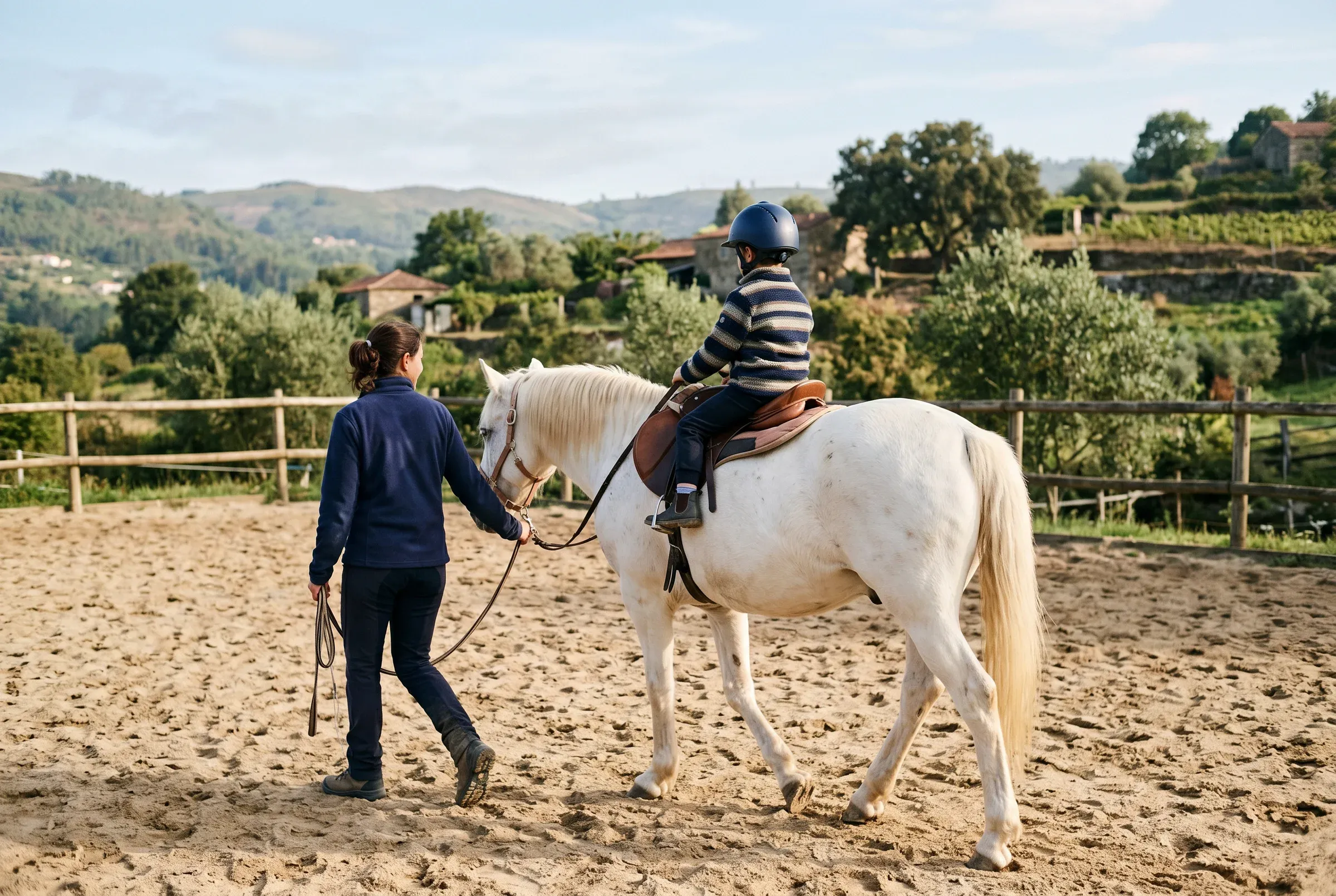
There is a particular kind of quiet at our yard in Areosa, on the northern edge of Viana do Castelo. The Atlantic murmurs beyond the dunes, Monte de Santa Luzia rises green behind us, and in the arena a horse stands patiently while a child reaches out to touch its neck for the first time. Nothing dramatic happens in that moment — a hand on warm coat, a long slow breath — and yet, for many of the families we work with, it is where everything begins.
Hippotherapy is one of the oldest ideas in rehabilitation dressed in a modern name: using the movement of a horse, guided by trained professionals, to support people whose bodies or minds need a different kind of help. At VIANAEQUESTRE, the riding association we founded here in 2009, it sits quietly alongside our beach rides and lessons — and for the people it touches, it is often the most meaningful thing we do.
If you are visiting the Minho for a while, spending a season near the Praia do Cabedelo, or settling in this corner of northern Portugal with a family member who might benefit, this guide explains what hippotherapy is, what the benefits really look like, and how a session works — including the free initial assessment we offer every family, with no obligation at all.
What exactly is hippotherapy?
The word comes from the Greek hippos, horse. Hippotherapy is not about learning to ride — that is what our riding lessons are for. Here, the horse is a therapeutic partner rather than a mount to be mastered. The participant does not steer or command; they receive the horse’s movement, while a trained team guides the session and keeps everything safe, working in step with any recommendations from the participant’s own doctors and therapists.
That distinction matters. In a lesson, progress is measured in skills. In hippotherapy, progress is measured in the person: steadier posture, calmer breathing, a new word spoken to a horse.
The horse’s three-dimensional movement
Why a horse, of all things? Because of something no machine has ever convincingly reproduced. When a horse walks, its back moves in three planes at once:
- Up and down with each stride;
- Forwards and back with the natural swing of the walk;
- Side to side as the horse’s hips rotate.
Sitting on that moving back, a person receives dozens of small rhythmic impulses every minute. Remarkably — and this is what has fascinated therapists around the world for decades — the pattern transmitted to the rider’s pelvis closely resembles the movement of human walking. Someone who struggles to walk, or who has never walked, can experience something very like the sensation of walking, safely, without bearing their own weight.
The body cannot ignore this gentle, constant invitation. It adjusts the trunk, seeks balance, organises posture — all without it ever feeling like an exercise. Add the horse’s warmth, its breathing, its steady presence, and you have a therapy that engages the whole person at once.
What the benefits look like
Let us be honest with you, because honesty is the only decent way to talk about therapy: hippotherapy is not a cure, and it does not replace medical treatment, physiotherapy or speech and occupational therapy. It is a complement — and for many families, a treasured one. The benefits described in the literature, and the ones we see week after week, tend to include:
For the body
- Stimulation of muscle tone and trunk control;
- Work on balance and motor coordination;
- Improved posture and body awareness;
- A rhythmic, repetitive stimulus that is very hard to recreate anywhere else.
For mind and emotions
- Growing self-confidence — sitting tall on a horse changes your perspective, quite literally;
- Moments of calm and emotional regulation, helped by the rhythm of the walk and the contact with the animal;
- Encouragement of attention, communication and the desire to interact;
- A genuine bond with the horse and the team, built session by session.
Progress is rarely linear and never identical from one person to the next. What we witness most often are not miracles but small, steady victories: a posture held a little longer, a smile that was not there before, a hand that finally relaxes on the horse’s mane.
Who is hippotherapy for?
Doctors and therapists most often recommend hippotherapy for children, young people and adults living with:
- Cerebral palsy and other neuromotor conditions;
- Autism spectrum conditions;
- Down’s syndrome and other genetic conditions;
- Global developmental delay;
- Difficulties with balance, coordination or posture;
- Anxiety and other challenges with emotional regulation.
There are also situations in which hippotherapy is not advisable, or requires particular precautions. That is why we always ask families to make the decision together with the health professionals who know the participant best — and we are happy to speak with those professionals directly if you wish. If in doubt, simply get in touch; a conversation costs nothing and clarifies everything.
What a session looks like at VIANAEQUESTRE
You will find us at Rua da Condominha 216, in Areosa — a few minutes from the centre of Viana do Castelo, between the ocean and the wooded slopes of Monte de Santa Luzia. It is a calm, unhurried place, which is exactly the point.
A typical session unfolds like this:
- Arrival and greeting the horse — touching, stroking, sometimes helping to brush. The bond is part of the therapy, not a warm-up for it.
- Mounting with support — always closely accompanied by the team, at each person’s own pace.
- Work at the walk — the horse moves, and the participant’s body responds; depending on the goals agreed for each person, we may add simple games, reaching exercises or quiet stretches of nothing but rhythm and breath.
- Saying goodbye — thanking the horse is, for many of our participants, the favourite moment of all.
We work with calm, experienced horses and keep everything deliberately small-scale. Even our beach horse rides never exceed eight riders per group; in hippotherapy, the attention narrows further still, to one participant at a time.
The initial assessment is free
Before any commitment, we invite every family to visit us for a free initial assessment. We meet, we listen to your story and your hopes, we introduce the horses and the grounds, and together we consider whether hippotherapy makes sense right now. Only then is a plan of sessions discussed. Prices are available on request and explained openly in that first conversation — never before you have had a chance to ask every question you carry.
To arrange a visit, send us a WhatsApp message on +351 934 142 212.
Frequently asked questions
We do not speak Portuguese. Can we still take part?
Yes. Much of hippotherapy happens beyond words — through rhythm, touch and the horse itself — and our team is used to welcoming international families to Viana do Castelo. Sessions can be conducted with English support, and the initial assessment is a relaxed conversation where we make sure everyone understands everything. Just mention your language when you message us on WhatsApp.
Does the participant need any riding experience?
None whatsoever. Hippotherapy is not riding in the sporting sense: nobody is expected to steer, trot or perform. The team supports the participant at every moment, from the ground and, when helpful, walking alongside the horse. Some participants spend their first sessions entirely on the ground, simply getting to know the horse — and that, too, is therapy.
How many sessions before we see results?
There is no honest universal answer, and we would encourage you to be wary of anyone who promises one. Hippotherapy works through regularity: most families choose weekly sessions, and changes tend to reveal themselves gradually, over weeks and months, differently in every person. During the free initial assessment we will talk through realistic expectations for your particular situation — and keep talking, honestly, as the sessions unfold.