

Ask a Portuguese friend for their favourite city and there’s a fair chance they’ll lower their voice, as if sharing a secret, and say Viana do Castelo. An hour north of Porto, where the River Lima meets the Atlantic, this small city has a basilica crowning its own mountain, a historic centre built on the gold of the sea trade, one of Europe’s best-loved kitesurfing beaches, and food that makes you rethink your flight home.
We know it better than most. VIANAEQUESTRE has been based in Areosa, on the wild coast just north of the city, since 2009 — and for over fifteen years we’ve been showing visitors the beaches and hills of the Minho from the best vantage point there is: the saddle. So consider this a local’s itinerary, not a listicle.
If you’re searching for things to do in Viana do Castelo, here are two days that cover the lot — the mountain, the old town, the beach, the table, the gold, and one ride you won’t stop talking about.
Day 1 — Santa Luzia, the old town and a hospital ship
Morning: ride the funicular up Monte de Santa Luzia
Start with the view that made the city famous. Monte de Santa Luzia rises directly behind Viana, topped by the Sanctuary of the Sacred Heart of Jesus — a domed basilica whose silhouette you’ll spot from all over town. From the terrace (or from the dome itself, if you don’t mind a narrow staircase) the panorama takes in the mouth of the Lima, the long sands of Cabedelo and the coastline running north towards Montedor. It regularly appears in round-ups of the finest views in Portugal, and once you’re up there you’ll understand why.
Getting up is half the fun: the Santa Luzia funicular — the longest in the country — leaves from beside the railway station and climbs the wooded hillside in a few minutes. The energetic can take the monumental staircase instead; everyone else buys a return ticket and feels no shame whatsoever.
Afternoon: Praça da República and the streets of the centre
Back at sea level, put the map away and wander. The heart of the old town is Praça da República, framed by a Renaissance fountain, the arcades of the old town hall and the extraordinary tiered façade of the Misericórdia. The narrow granite streets around it are lined with goldsmiths’ windows, Manueline doorways and old-school pastry shops where coffee still comes with conversation.
Late afternoon: step aboard the Gil Eannes
Down on the quay sits a great white ship with a remarkable past. The Gil Eannes was a hospital ship that supported Portugal’s cod-fishing fleet in the icy waters off Newfoundland and Greenland; today it’s a museum, and walking its wards and engine rooms brings home just how hard those Atlantic campaigns were. It’s genuinely gripping — for adults and children alike — and the evening light over the Lima afterwards is the perfect finish to day one.
Day 2 — Cabedelo beach, then the coast on horseback
Morning: cross the river to Praia do Cabedelo
Cross the iron bridge — built by Gustave Eiffel’s engineering house — to the south bank and you’ll find Praia do Cabedelo: dunes, pine woods and a sweeping beach that ranks among Europe’s most respected spots for kitesurfing and windsurfing. On a breezy morning the sky fills with kites, and even if you never touch the water, the boardwalk stroll is worth it for the view alone — the city and Santa Luzia stacked behind the river mouth like a stage set.
Afternoon: the highlight — riding the wild coast at Areosa
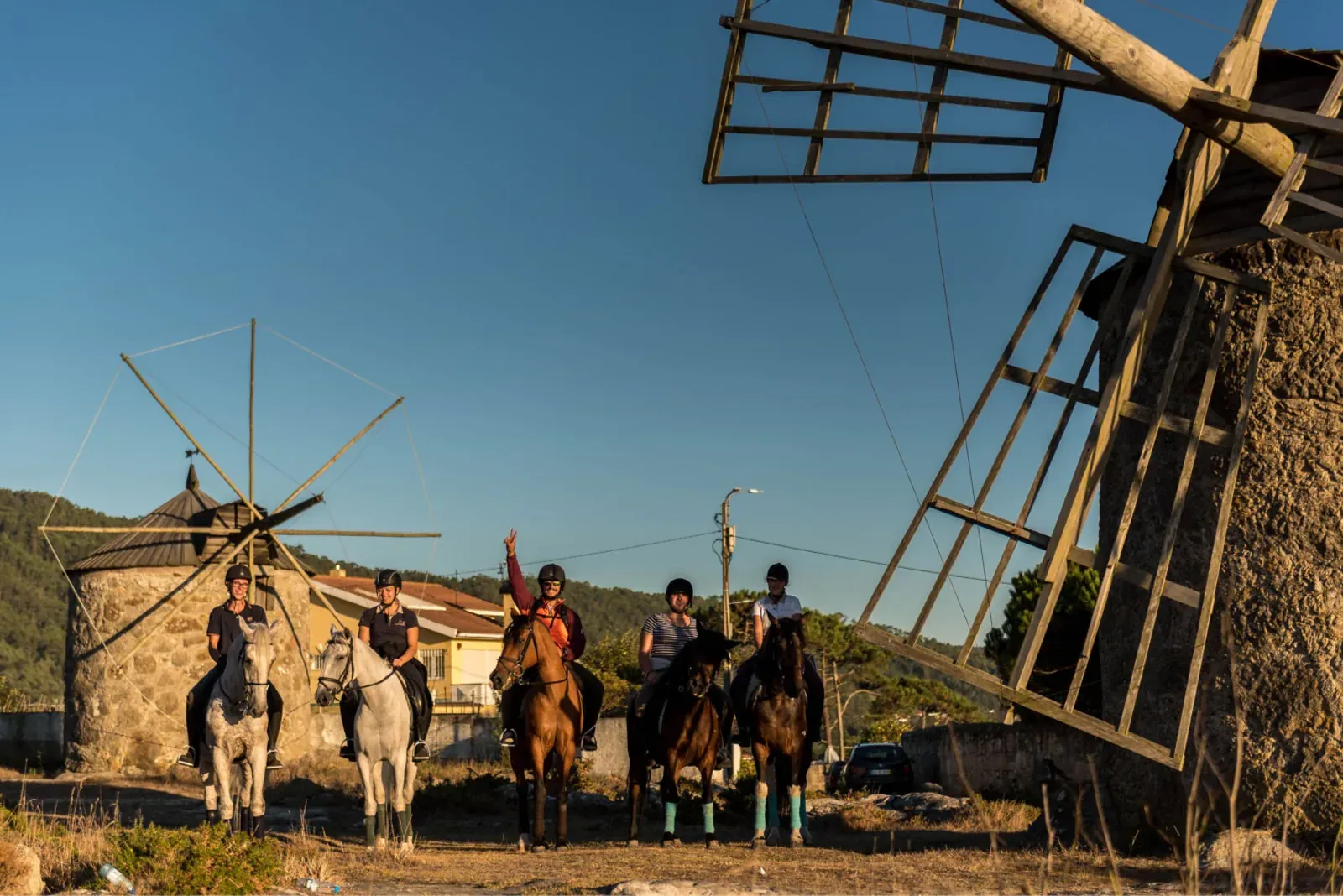
We saved the best for last. In Areosa, the coastal parish just north of the centre where green fields tumble down to the rocks, you’ll find our equestrian centre at Rua da Condominha 216. From here we ride out to wild, near-empty beaches and along trails past the old stone windmills of Montedor — always in small groups of eight riders at most, always with experienced guides. No riding experience is needed: our beach horse ride is designed for complete beginners as well as seasoned riders.
Want to turn the ride into a full Minho afternoon? Our Premium Minho Experience pairs the ride with a tasting of local vinho verde, regional delicacies and a showcase of Viana’s crafts — the whole region in one unhurried programme. And if the weather plays along, the sunset beach ride is the kind of golden-hour memory people plan entire trips around. Prices on request — a quick WhatsApp message to +351 934 142 212 is all it takes to book.
Got a third day? Head inland to Serra d’Arga, a granite massif of schist villages, crystal-clear rock pools and free-roaming garranos — the small, hardy wild ponies of the Minho.
What to eat in Viana do Castelo
The Minho takes its table seriously, and Viana is no exception. Don’t leave without trying:
- Fresh fish and seafood — the fish market is minutes away and menus show it; ask for the catch of the day.
- Hearty Minho classics — arroz de sarrabulho and rojões, rich pork dishes best tackled hungry.
- Bacalhau — salt cod, in a city that spent centuries fishing for it, is practically a civic duty.
- Local sweets — torta de Viana and the almond pastries of the old confeitarias.
- Vinho verde — you’re in its heartland; a chilled Loureiro from the Lima valley alongside grilled fish is the region on a plate.
What to bring home: embroidery, filigree and the Heart of Viana
Viana’s souvenir culture is the real thing. The famous Viana embroidery — bold red and blue motifs on linen — decorates everything from tablecloths to the traditional festival costume. And the city’s goldsmiths still produce filigree by hand, including its most iconic piece: the Coração de Viana, the Heart of Viana, a lacework of fine gold thread you’ll see in every jeweller’s window in the old town, from small pendants to heirloom-sized showpieces.
Time your visit for August and you’ll see the gold worn as it’s meant to be: during the Romaria d’Agonia, the city’s great festival, women parade in traditional dress with layers of family filigree at their necks — generations of gold in a single afternoon.
Frequently asked questions
Is Viana do Castelo worth visiting from Porto?
Absolutely — it’s one of the easiest and most rewarding day trips or overnights in northern Portugal, roughly an hour from Porto by car or direct train. That said, two days let you do it justice: the mountain and old town on day one, Cabedelo and a horse ride on the Areosa coast on day two. Most visitors wish they’d stayed longer.
Can complete beginners join the horse rides?
Yes — most of our guests have never ridden before. Groups are capped at eight riders, the pace is set to suit everyone, and our team accompanies you throughout. If you have a health condition or any specific concern, please check with us before booking so we can advise properly — just reach out via our contact page or WhatsApp +351 934 142 212.
When is the best time of year to visit?
May to September brings the most sunshine, with the spectacular Romaria d’Agonia festival in August. Spring and autumn mean mild weather, fewer crowds and beautiful light. We ride all year round — in winter the coast turns wilder and more dramatic, and having a beach entirely to yourselves is its own kind of luxury.