

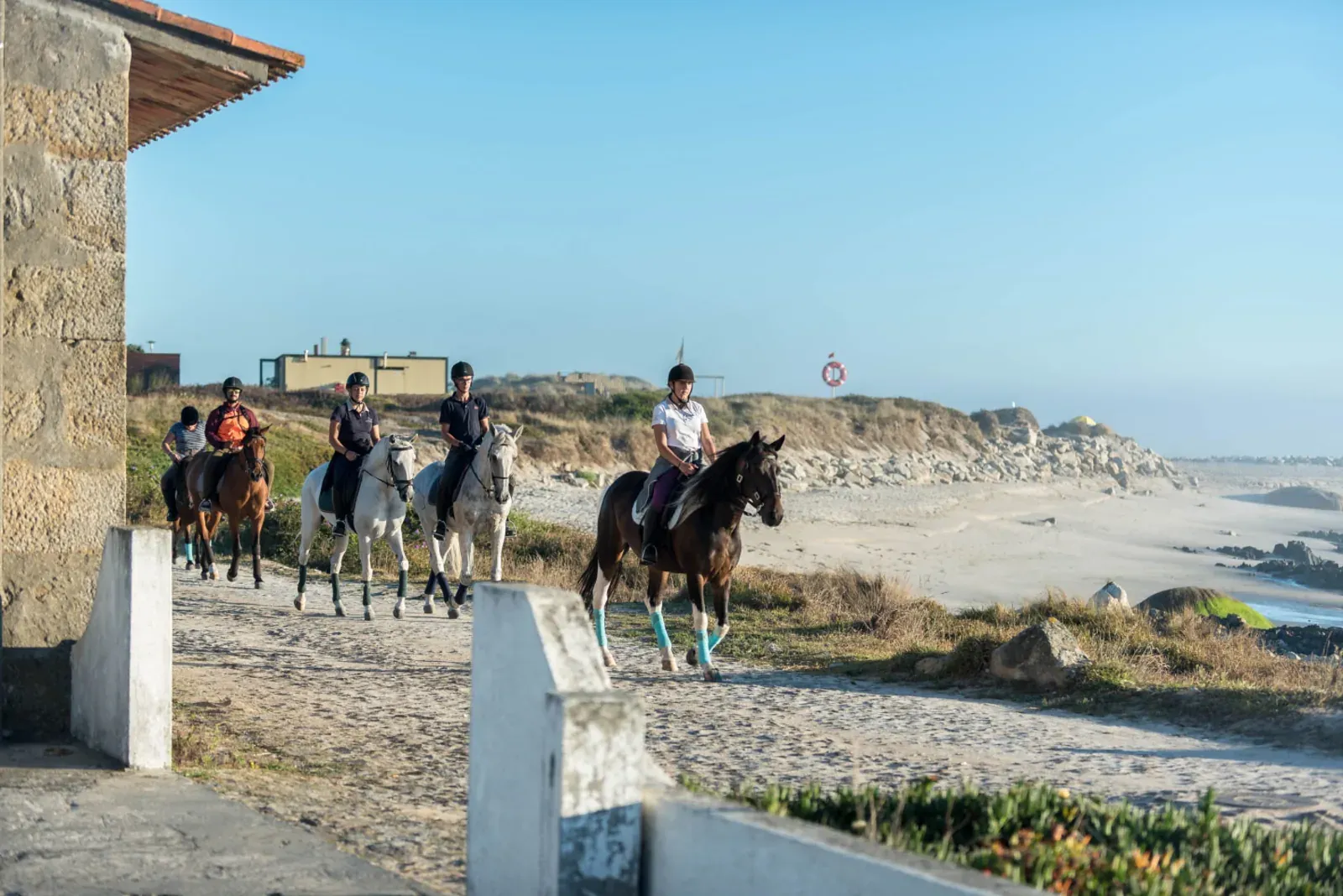
There is a moment we witness almost every week at our yard in Areosa, on the edge of Viana do Castelo. A visitor steps out of the car, spots the horses, and does the classic double-take: they’re bigger than I expected. The palms go slightly sweaty. Someone makes a joke about updating their will. And then, an hour and a half later, that same person is walking along the sand with the Atlantic on one side and a grin they will be wearing for the rest of their holiday.
We have been welcoming first-timers since 2009 — honeymooners, hen parties on unexpectedly good behaviour, grandparents ticking off a bucket list — so take it from us: you do not need to be a rider to love a horseback tour. You need curiosity, sensible shoes and about ten honest tips.
Here they are, with no jargon and no pretending you’ll be galloping like a film star by lunchtime. You won’t. That is entirely fine. A first ride is meant to be savoured, not survived.
Before you leave your hotel
1. Being nervous is normal (and, frankly, sensible)
If your heart rate climbs at the thought of sitting on half a tonne of animal, congratulations: you are a functioning human being. First-ride nerves are so common they are practically part of the itinerary. The trick is not to hide them. Tell us how you’re feeling when you arrive — we’ll match you with the most patient horse in the stable, keep the pace gentle and stay close until your shoulders come back down from wherever they were hiding, somewhere near your ears.
2. Footwear matters more than you think
The rule is simple: closed, comfortable, with a firm sole. Trainers or walking boots are perfect. Flip-flops, sandals and box-fresh shoes you’re precious about should stay at the hotel — you’ll be walking on sand, on farm tracks and, let’s be honest, possibly through something a horse left behind. The helmet is not your problem: we provide it, along with the rest of the safety equipment.
3. Dress for the Minho, not for the photo
Long, comfortable trousers (stretchy jeans or leggings), layers you can add and remove, and a windproof jacket in case the Atlantic is in a mood. The weather in this corner of northern Portugal changes its mind readily: you can leave Areosa under sea mist and reach the beach in full sunshine, with the basilica on Monte de Santa Luzia glowing on the hillside behind the town. The good photo happens either way — promise.
Meeting your horse
4. There are no silly questions — truly
“Can the horse tell I’m scared?” (Yes, and it doesn’t hold it against you.) “What if it just bolts?” (It won’t; our trail horses have seen everything from tractors to bagpipes.) “Am I allowed to pat it?” (Allowed and encouraged.) We have heard every version of every question, hundreds of times, and we still enjoy answering them. The only question that makes us sad is the one you keep to yourself — usually the exact one that was spoiling your fun.
5. Sit tall and look where you want to go
Forget the instinct to cling to the saddle like a life ring. The position that actually works is surprisingly dignified: back straight but relaxed, heels slightly down, eyes up and ahead — on the trail, on the sea, on the lighthouse at Montedor up the coast. Horses follow your body’s direction. Spend the ride staring at the ground and you can guess where your balance, and your attention, will end up.
6. Soft hands — the reins are not handlebars
This is the number-one beginner mistake, and it’s completely understandable: when the brain gets startled, the hands clamp shut. But the reins connect to the horse’s mouth, which is a sensitive place. Yanking hard doesn’t brake faster — it just confuses and annoys. Instead, imagine you’re carrying two very full cups of tea: firm enough not to drop them, light enough not to spill. We demonstrate all of this calmly in the arena before heading out.
Out on the trail
7. Trust your horse — it has done this hundreds of times
Your horse knows every bend, puddle and bramble between Areosa and the shoreline. It knows where to place its feet, it knows how to follow the horse in front, and above all it knows the way home — on that last point, it is arguably more motivated than you are. Our beach horse ride runs in small groups of eight riders at most, always accompanied by our guides. Your job is not to control everything; it is to come along for the ride.
8. Breathe out — your whole body will thank you
Hold your breath and everything follows: legs grip, hands pull, and the horse starts wondering what on earth is happening up there. Try this simple trick: every so often, exhale like you’re sighing at a dull meeting. It works almost comically well — your body softens, the horse softens, and suddenly you’re admiring the Serra d’Arga on the horizon instead of doing mental arithmetic about mortality. Rumour has it the wild garrano ponies up on that mountain use the same technique. (They don’t. But it would suit them.)
9. Calm voice, calm movements
Horses are peaceful animals that appreciate peaceful company. You can chat, laugh and enjoy the group — this is a beach ride, not a funeral — but skip the sudden shouts, the windmilling arms and the acrobatic celebrations in the saddle. Want photos? Just tell your guide and we’ll stop somewhere scenic. There’s no shortage of candidates: arriving on the open sand, with Cabedelo Beach across the river mouth, tends to produce a respectful silence all by itself.
After the ride
10. Accept that one ride is rarely enough
Fair warning: the first ride is habit-forming. Some guests discover they want to learn properly and book riding lessons on a return trip. Others come back with friends for the sunset beach ride. And plenty round off the day the local way — wandering Viana do Castelo’s old town with a chilled glass of vinho verde, or timing their holiday for the Romaria d’Agonia festivities in August. We wouldn’t dream of judging. We’d probably join you.
Tempted? We’re easy to find: Rua da Condominha 216, in Areosa, a few minutes from the centre of Viana do Castelo — itself about an hour north of Porto. Message us on WhatsApp (+351 934 142 212) or through our contact page and we’ll sort out dates and times, with prices on request.
Frequently asked questions
Do I need any riding experience for the beach tour?
None at all. Most of our guests are riding for the very first time. Before setting off, we run a short introduction in the arena — mounting, holding the reins, stopping — and match you with a horse that suits your build and confidence level. Groups are capped at eight riders and always accompanied by our team.
I have a bad back / I’m pregnant. Can I still ride?
That depends on your individual situation, and your health isn’t something to guess about. Please speak to your doctor first, then message us: we’ll describe the ride in detail — pace, duration, terrain — so you can make an informed decision. If riding isn’t advisable, gentler options such as our carriage rides let you enjoy the same landscapes, and we also run supervised hippotherapy programmes.
How do I book from abroad?
The easy way is WhatsApp: send +351 934 142 212 a message with your preferred date and group size, and we’ll reply with the available options — prices on request, as they vary by tour, duration and group. English is no problem. Booking a few days ahead is wise, especially in summer and at weekends, since small groups mean spaces genuinely do fill up.