

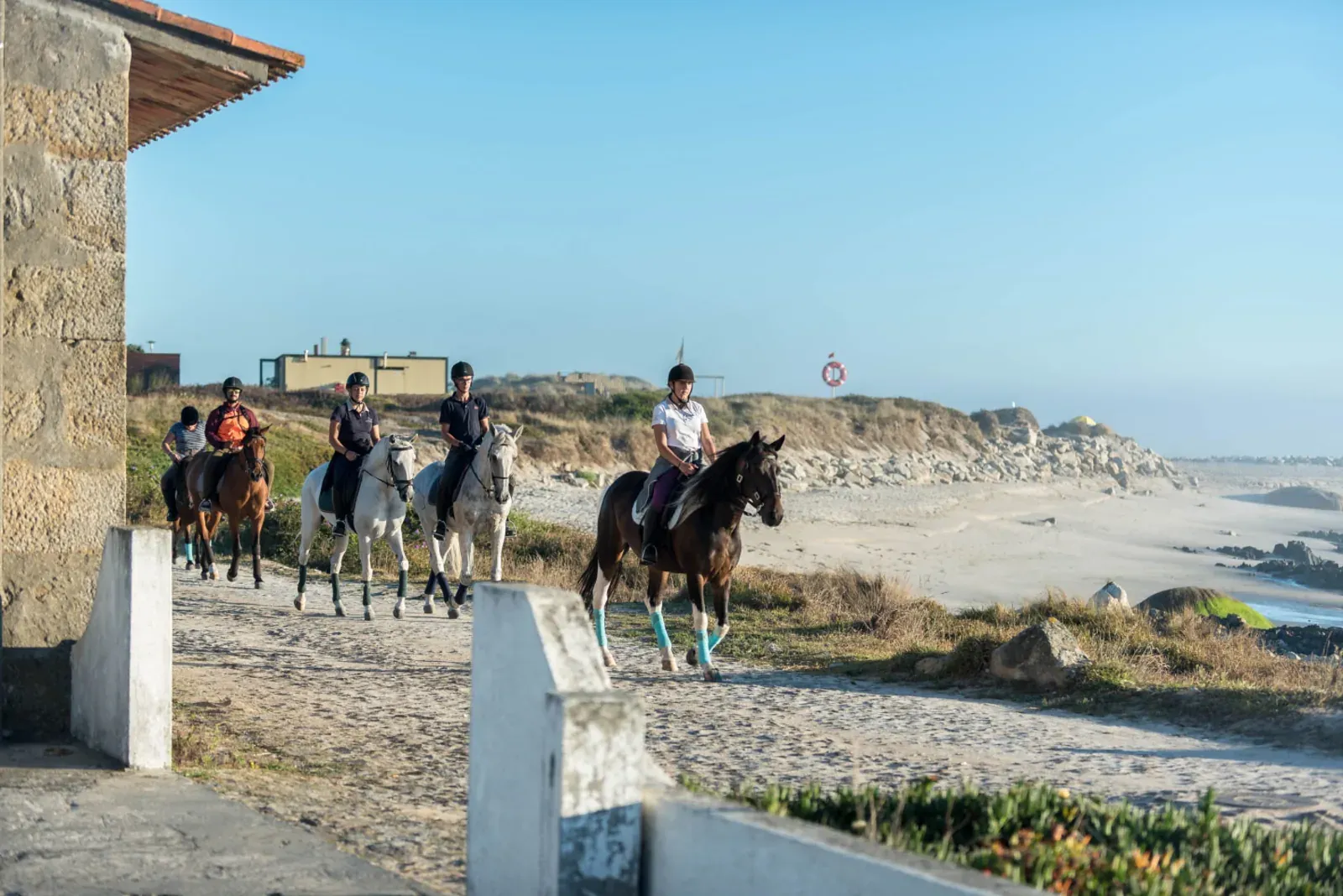
On a granite wall in Areosa, just north of Viana do Castelo, there is a yellow arrow that has pointed the way for thousands of people. Past it walk pilgrims who left Porto four days ago, others who set out from Esposende that very morning, all of them bound for Santiago de Compostela. In the parish where we have worked with horses since 2009, pilgrims are simply part of the landscape — as much as the sea, the maize fields and the windmills of Montedor.
The Portuguese Coastal Camino (Caminho Português da Costa) is one of Europe’s fastest-growing pilgrim routes. It begins in Porto, hugs the Atlantic through Vila do Conde, Póvoa de Varzim and Esposende, crosses the River Lima at Viana do Castelo, then hops over the Minho estuary by boat at Caminha into Galicia — Baiona, Vigo, Pontevedra — before arriving at the cathedral square in Santiago. Roughly 270 kilometres, with the ocean almost always on your left.
We will happily admit our bias, but we believe Viana do Castelo is the loveliest stop on the entire Portuguese section. Consider this a guide written by neighbours: the stages, the sights, where to sleep — and one suggestion for your rest day that involves low tide, wet sand and a horse.
The two stages that meet in Viana
Arriving: Esposende to Viana do Castelo (around 25 km)
The morning rolls through pine woods and smallholdings, but the moment nobody forgets comes early. In Castelo do Neiva, a modest church dedicated to Santiago holds an inscription dated 862 AD and is widely considered the oldest church devoted to the apostle outside Galicia. Pause for a minute — this route was not invented for tourism; it was already ancient when Portugal became a country.
Chafé, Vila Nova de Anha and Darque follow, until the River Lima opens up ahead and you cross it on the Eiffel Bridge, the iron span of 1878 that links the two banks. Walking into Viana across that bridge, with the Sanctuary of Santa Luzia standing guard on its hilltop, is one of the most photographed arrivals on the whole Camino.
Leaving: Viana do Castelo to Caminha (around 27 km)
The way out threads through the old town and soon reaches Areosa, following farm lanes and clifftop paths. From there, the coast puts on a show:
- the windmills of Montedor and mainland Portugal’s northernmost lighthouse;
- the rock pools and dry-stone field walls of Carreço;
- the wild, often empty beach at Afife and the Gelfa pine forest;
- Vila Praia de Âncora and Moledo, with the Serra d’Arga closing the horizon inland;
- Caminha, where a small boat ferries you across the Minho estuary to A Guarda, in Spain.
Many pilgrims call this the most beautiful stage of the entire Coastal Camino. Having ridden these trails on horseback for more than fifteen years, we find it hard to disagree.
What to see when the rucksack comes off
Viana deserves more than a hurried overnight between stages. If your schedule allows it, stay.
- Monte de Santa Luzia — ride the longest funicular in Portugal (or take the steps, if your legs allow) up to the basilica. The view over the Lima estuary is among the most celebrated in the country, and behind the church the ruins of an Iron Age hill settlement add two thousand years of perspective.
- The old town — Praça da República with its Renaissance fountain, the Misericórdia church, the cathedral, and jewellers’ windows glittering with the gold filigree heart of Viana.
- The Gil Eannes — the former hospital ship that once served Portugal’s cod fleet, now moored in the dock as a museum; there are even bunks aboard for travellers.
- Praia do Cabedelo — across the river on the south bank, a broad, windswept beach shared by bathers, kitesurfers and sails.
- Romaria d’Agonia — if you pass through in August, brace yourself: flower carpets on the streets, women in traditional dress wearing layers of gold, giant parading figures, and three days when the city simply does not sleep.
At the table, order the fish of the day and a cold bottle of vinho verde. The next stage can wait.
Where pilgrims sleep and stamp their credencial
Viana’s pilgrim hostel sits in the town centre, next to the Carmo church — arrive early in high season, as beds go quickly. The city also offers a youth hostel, guesthouses and hotels of every description, many of them well used to walkers who want an early dinner and a sunrise departure.
Do not forget your stamp: you will find one at the tourist office, in churches and in plenty of cafés along the way. Between July and September, booking your bed a day or two ahead spares you sore-footed surprises.
Horses and the Camino: a partnership as old as the route
In the Middle Ages, anyone who could afford it rode to Santiago — nobles, knights, bishops and merchants — and the inns along the way kept stables the way hotels now keep wi-fi. It is no accident that the apostle himself is so often depicted on horseback.
The tradition never died. To this day, the Pilgrim’s Office in Santiago grants the Compostela certificate to those who cover at least 100 kilometres on horseback, subject to its own documentation requirements — check the current rules before planning that adventure. And the Alto Minho remains horse country: up in the Serra d’Arga, the garranos, the region’s native ponies, still roam in semi-freedom as they have for centuries. Should you ever ride the Camino with your own horse, we offer horse boarding in Areosa, a stone’s throw from the trail.
Our tip: spend your rest day in the saddle
After two back-to-back stages of 25 kilometres, your feet have earned a day off — and Viana is the right place to take it. Our neighbourly suggestion: swap your boots for stirrups.
Our beach horse ride sets off from Areosa, right beside the Camino, and follows the same farm lanes down to the shore — minus the rucksack, and at a rhythm the horses know better than anyone. Groups are small (a maximum of 8 riders), certified instructors lead every outing, and most of our visitors are in the saddle for the very first time. If you would rather end the day in style, there is also our sunset beach ride, with the Atlantic blazing on the horizon.
Prices are on request and booking takes one WhatsApp message to (+351) 934 142 212 — tell us you are walking to Santiago and we will sort out the rest. You will find us at Rua da Condominha 216, Areosa; all the details are on our contact page. Bom caminho — see you soon!
Frequently asked questions
Where should I start the Portuguese Coastal Camino to earn the Compostela?
To receive the Compostela you must walk at least the final 100 kilometres into Santiago. From Viana do Castelo it is roughly 150, which makes the city a popular starting point for anyone with a week to spare: six to seven stages, the sea in sight most of the way, and a comfortable margin for the certificate. The rules are set by the Pilgrim’s Office in Santiago, so confirm the current requirements before you set out.
Can you do the Camino de Santiago on horseback?
Yes — the tradition is alive, and the Compostela is still granted to pilgrims who complete at least 100 kilometres mounted. Be warned that the logistics are demanding: stabling at every stage, a farrier on call, transport home for the horse. Always confirm the up-to-date conditions with the Pilgrim’s Office, and if you need support around Viana do Castelo, get in touch with us.
Do I need riding experience for the beach ride?
No. Most of our visitors have never sat on a horse before: we begin with a short introduction in the arena, match you with a calm horse suited to your build and confidence, and keep an instructor close by throughout, helmets on. We welcome riders from 8 years old, and during the summer bathing season we adapt routes and timings to the beach-access rules. Prices are on request; if you have any health or mobility concerns, the safest course is to check with us before booking.