

Ask anyone in Viana do Castelo where the city goes to swim and you will get a one-word answer: Cabedelo. The beach sits on the south bank of the River Lima, in the parish of Darque, directly opposite the old town — close enough that from the sand you can pick out the domed basilica crowning Monte de Santa Luzia across the water.
And yet Cabedelo beach feels like two beaches stitched together. On one side, the long breakwater tames the river mouth into a sheltered, almost lagoon-like corner. On the other, the open Atlantic rolls in, combed every summer afternoon by the nortada — the reliable north wind that has made this stretch of sand famous among kitesurfers across Europe. Between the two runs a ridge of dunes crossed by wooden boardwalks, with a shady pine forest waiting behind.
If you are basing yourself in Viana do Castelo — an easy and criminally underrated stop on the Minho railway line north of Porto — Cabedelo is the beach day you should not skip. Here is how to get there, what to do on the water and off it, where to eat, and how to see this same coastline from the back of a horse.
Getting there: the little ferry or the Eiffel bridge
Across the water
In the bathing season, a small passenger ferry usually shuttles between the centre of Viana do Castelo and Cabedelo. The crossing takes only a few minutes, but it doubles as the best viewpoint in town: the marina masts slipping past, Santa Luzia rising behind the rooftops, the dunes growing ahead of you. The service is seasonal and timetables change from year to year, so check with the tourist office before you build your day around it.
Over the bridge
Drivers cross the Lima either on the A28 motorway (exit at Darque) or over the Ponte Eiffel, the wrought-iron bridge delivered in 1878 by Gustave Eiffel’s workshop — an attraction in its own right. There is parking near the pine forest, and boardwalks carry you the last stretch over the dunes. You can also walk or cycle across the Eiffel bridge from the town centre; the view over the river mouth is worth every extra step.
Surf in the morning, kite in the afternoon
Cabedelo runs on its own clock, and it is wound by the wind. Mornings tend to be calmer and cleaner — surf time — with the corner beside the breakwater offering the most forgiving waves. That is exactly where the local surf schools take first-timers. Then, after lunch on most summer days, the nortada arrives almost on schedule and the beach changes films entirely: dozens of colourful kites climb into the sky and the sand becomes a launch strip. It is this consistency that makes Cabedelo one of Portugal’s most dependable kitesurfing spots.
A few practical notes:
- Learning? Surf and kite schools operate right by the beach, gear included — by far the safest way to start.
- Just watching? The sand near the breakwater is a front-row seat for the afternoon show.
- Bringing your own kit? Respect the kite launch corridors and the areas marked out for swimmers.
Dunes, boardwalks and the pine forest
Even if you never touch the water, Cabedelo earns the trip. The dune ridge here is among the loveliest on Portugal’s northern coast: soft hills of sand stitched together by marram grass. Stay on the wooden boardwalks — the dunes are fragile and take decades to recover from shortcuts.
Behind them waits the pine forest: deep shade for the hottest hours, flat sandy paths perfect for a slow run or an easy bike loop, and that resin-and-cicadas atmosphere Portuguese childhood summers are made of. Come back to the sand for the finale, when the sun drops into the Atlantic and, across the river, the lights of Viana do Castelo and the floodlit basilica of Santa Luzia switch on. Not bad for a beach ten minutes from the centre of town.
Where to eat: beach doughnuts to seafood rice
- On the sand: the beach bars handle small hungers — toasted sandwiches, snacks, cold drinks — and keep an eye out for the bola de Berlim, the custard-filled doughnut that is Portugal’s unofficial beach snack.
- In Darque: unfussy neighbourhood grills serving honest fish and daily specials at local prices.
- Across in Viana, one crossing away: seafood rice, grilled sea bass, octopus à lagareiro — chased with a cold glass of vinho verde, the Minho’s young, lightly spritzy white wine.
One timing tip: in August the Romaria d’Agonia, one of Portugal’s great folk festivals, fills the city with processions, drummers and towering gigantones. It is magical — but book your table, and your bed, well in advance.
The same coast, from the saddle
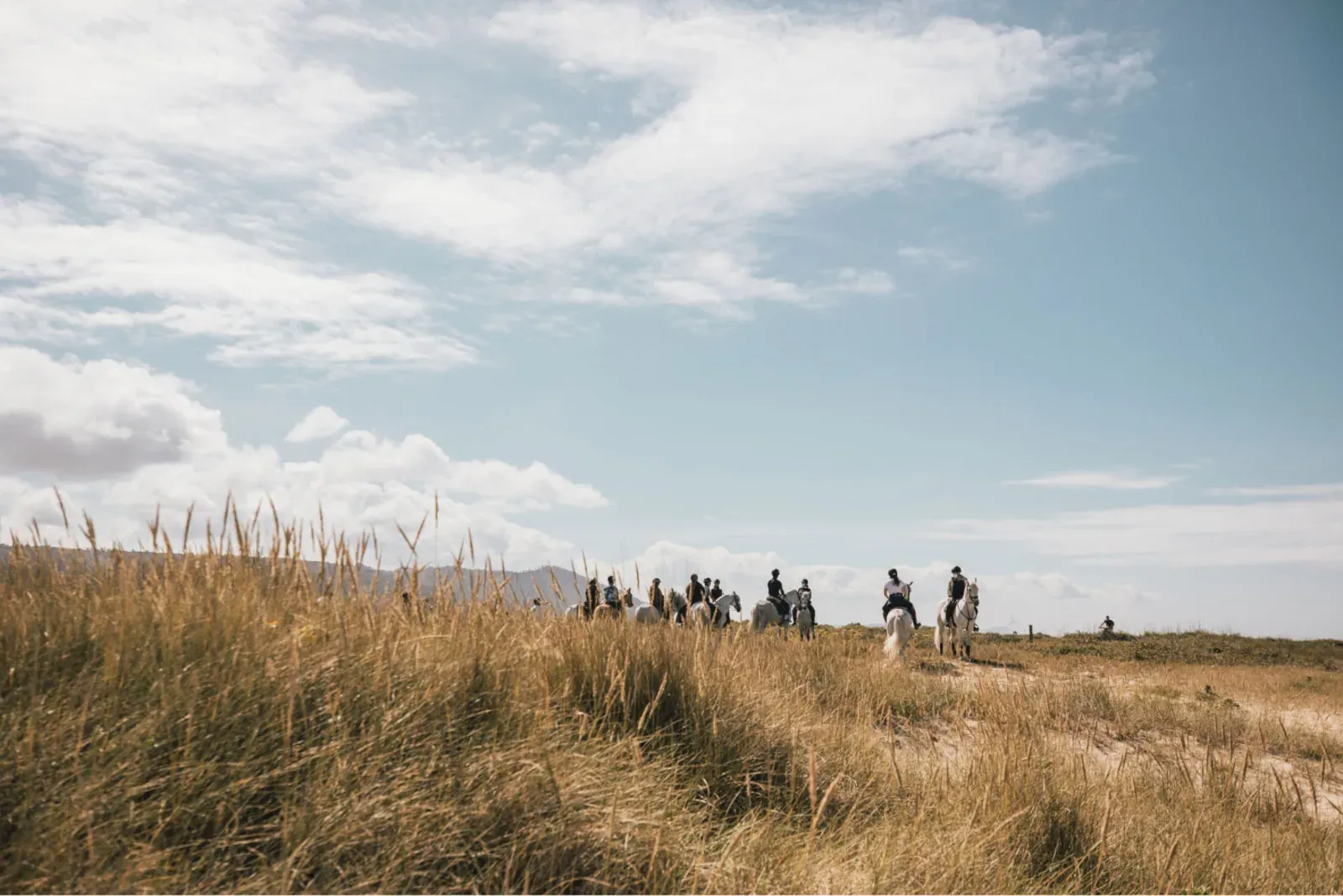
Here is where we come in. VIANAEQUESTRE, Viana do Castelo’s riding association, has been running horses on this coastline since 2009 from Rua da Condominha 216 in Areosa — the coastal parish on the north bank, between the city and the Montedor lighthouse. Our beach horse ride follows that wilder northern shore: open sands, rocky coves and green fields, with the Atlantic as a constant companion.
We keep groups small — never more than 8 riders — so nobody spends the hour staring at the tail in front of them, and beginners get real attention. For the full postcard, the sunset beach ride times the horses’ stride to the best light of the day. And if the coast leaves you wanting more, our mountain trail ride climbs into the Serra d’Arga, where garranos — the Minho’s semi-wild ponies — still roam free among the granite.
A near-perfect Viana day, if you ask us: surf or kite at Cabedelo in the morning, a long fish lunch, then a ride on the Areosa side as the light softens. The river sits in the middle; the light is the same. Prices on request; bookings by WhatsApp on +351 934 142 212.
Frequently asked questions
Does the Cabedelo ferry run all year?
As a rule the river crossing is seasonal, concentrated in the summer bathing season, and timetables vary from year to year. Check with the Viana do Castelo tourist office or the operator before relying on it. Outside the season, cross by the Ponte Eiffel — on foot, by bike or by car — or take the A28 and exit at Darque.
Is Cabedelo beach suitable for beginner surfers and kitesurfers?
Yes — it is one of the friendlier places on this coast to learn. The corner beside the breakwater is sheltered, and local schools provide qualified instructors and equipment. That said, this is still the open Atlantic and the afternoon nortada is a serious wind: go with a school your first time, and always follow the flags and the lifeguards’ instructions.
Can I ride a horse on Cabedelo beach itself?
Our rides depart from our base in Areosa, on the north bank of the Lima, where we know every stretch of sand. Rules on riding horses on beaches vary by beach and by season, so the simplest thing is to message us: we will tell you exactly what is possible and put together the right plan for your group. Reach us on WhatsApp at +351 934 142 212 or through our contact page.