

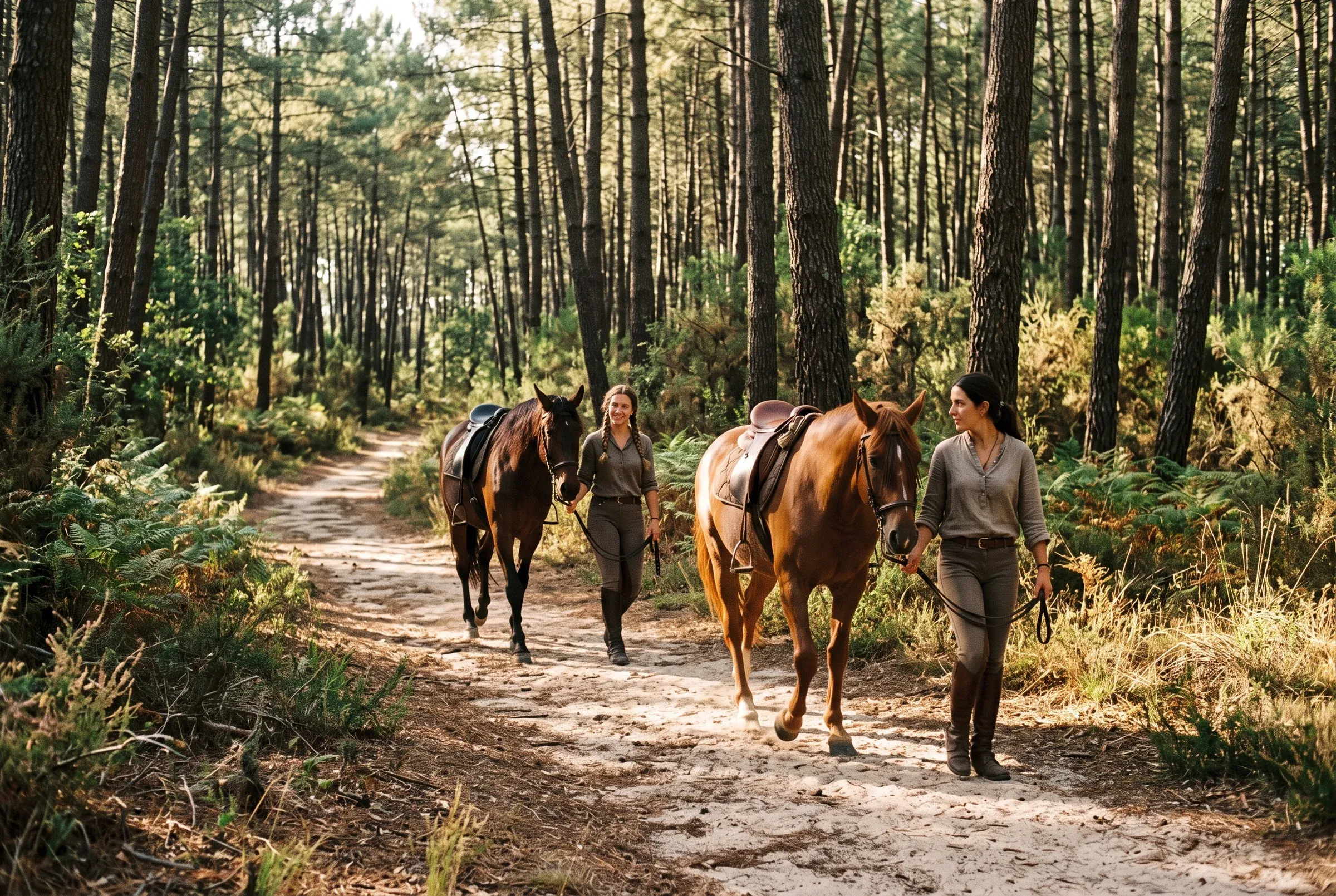
What to Wear Horseback Riding on the Beach (and What to Leave at the Hotel)
7 min read
You’ve booked a horse ride on a wild Atlantic beach in northern Portugal. The horses are sorted, the guide is sorted, the scenery has been sorted for a few million years. Which leaves the one question we get on WhatsApp more than any other, usually within minutes of confirming a booking: “What should I wear?”
Here’s the reassuring answer: nothing you don’t already have in your suitcase. Since 2009 we’ve welcomed riders from all over the world to our stables in Areosa, just north of Viana do Castelo — honeymooners who’d never touched a horse, families squeezing a ride between beach days, seasoned riders detouring through the Minho. Almost all of them rode in clothes they’d packed for an ordinary holiday. The trick isn’t buying equestrian gear; it’s choosing wisely from what’s already in your luggage.
What follows is our honest checklist, refined over thousands of rides between Praia do Cabedelo and the granite trails of Serra d’Arga. And because we ride on the edge of the Atlantic, it includes a few things the generic guides never mention: a north wind with a mind of its own, salt haze, and sunshine that burns quietly even in October.
Long trousers, non-negotiable (yes, even in August)
Rule number one, no exceptions: long trousers. Over an hour or two in the saddle, the inside of your leg is in constant contact with the leather. In shorts, that friction turns into chafing remarkably fast — and nobody wants to climb the steps of Monte de Santa Luzia the next day walking like a cowboy.
What works brilliantly:
- Stretchy jeans — the classic nearly everyone packs anyway
- Thick leggings or yoga trousers (thin ones let the saddle seams through)
- Joggers or hiking trousers with a bit of give
Avoid very loose trousers (they ride up and leave your calves exposed), stiff fabrics with no stretch, and heavy inner seams. And one warning from people who have seen it all: a wet swimsuit under your trousers is a guaranteed recipe for misery. If you’re coming straight from the beach, change first.
Closed shoes — your trainers are absolutely fine
You do not need riding boots. What you need is closed footwear that fits snugly and has a sole with some grip for the stirrup. Ordinary trainers, ankle boots or lightweight walking shoes all do the job perfectly.
What stays on solid ground, no negotiation: flip-flops, sandals, sliders, Crocs and anything that could slip off mid-ride. Stirrups are designed for closed shoes — this one is about safety, not style.
What about sand and seawater?
On our beach horse ride, the horses sometimes walk close to the waterline, and the odd splash is part of the magic. So don’t bring your most treasured shoes — a pair of trainers that have already lived a little is the ideal choice. On the mountain trails, a sole with a bit of tread helps during the short stretches on foot, but nothing technical is required.
Layers: the Atlantic writes its own forecast
Anyone who knows this coast will tell you: the morning can dawn with fog rolling over the Montedor lighthouse, midday can turn gloriously sunny, and by three o’clock the nortada — our famous north wind — may arrive with real enthusiasm. Dressing in layers here isn’t travel-blog filler; it’s basic seaside wisdom.
The formula we recommend all year round:
- Base layer: a t-shirt or long-sleeved top, depending on the season
- Warm layer: a jumper or fleece that’s easy to peel off and tie round your waist
- Outer layer: a light windproof jacket, essential from October to May
In winter, add thin gloves — your hands are always the first to complain about the wind. And if you’re joining our sunset beach ride, bring the warm layer even at the height of summer: the moment the sun drops into the Atlantic, the temperature on the sand falls several degrees in minutes, and the ride home happens in the cool of early evening.
One note of caution: skip loose scarves, ponchos and anything that flaps dramatically in the wind. Our horses are calm and used to almost everything, but billowing fabric is an unnecessary distraction — for them and for you.
Sun cream, even when the sky says otherwise
This is the most common mistake among visitors outside high summer. Light bouncing off the sea and the sand burns even on overcast days, and on a one-to-two-hour ride there’s no shade worth mentioning. Put sun cream on before you leave your hotel — face, neck, ears and hands, the areas that stay exposed once your helmet is on.
You won’t need a hat (more on that in a moment), but a lip balm earns its keep in the windy months. If you have particularly sensitive skin or a medical condition that affects sun exposure, please check with your doctor and mention it when booking — we’re happy to adjust timings and routes where we can.
Phones, cameras and the helmet (the part that’s on us)
Two questions we hear on every single ride, answered in one go.
Can you bring your phone or camera? Yes — as long as it travels in a zipped pocket or a small bag strapped to your body. No phones in hand while the horses are moving, and no open pockets that empty themselves at the first trot. And there’s a plan B: our guides know the most photogenic spots on every route and take photos of the group at the right stops. Relax, watch the wild garrano ponies on the hillsides, and let the pictures come to you.
And the helmet? That one’s on us. We provide helmets in a full range of sizes, including children’s, and we fit one to every head before anyone gets near a stirrup. Helmets are compulsory on all our rides and riding lessons — no exceptions, whether you’re a complete beginner or grew up in the saddle. Leave hats and caps behind: they don’t fit under a helmet and the Areosa wind collects them as souvenirs.
What to leave at the hotel
To finish, the list of things that are happiest staying in your room:
- Flip-flops, sandals and any open footwear
- Shorts (you know why by now)
- Rings, loose bracelets and watches you’d cry over
- Expensive sunglasses without a retaining strap
- Large rucksacks — they unbalance you; a small crossbody bag is plenty
- Strong perfume (horses have far better noses than we do)
- Umbrellas, obviously
Unsure about a specific item? Message us on WhatsApp (+351 934 142 212) before you set off — we reply quickly, and we’ve saved many a pair of wrong shoes just in time.
Frequently asked questions
Do I need to buy riding boots or jodhpurs for a holiday ride?
No. For our rides on the beach, through the pine forest or up in the hills, comfortable sportswear and closed trainers are entirely suitable. Proper riding gear only makes sense if you ride regularly — and if you catch the bug here, we can talk about it at your first lesson.
What happens if it rains on the day?
Minho weather changes quickly, and a fine drizzle rarely spoils a ride — some say it adds a certain green-and-misty romance, best toasted afterwards with a glass of vinho verde. In heavy rain or dangerous wind, safety always decides. Message us on WhatsApp the evening before or on the morning of your ride and we’ll work out the best option together, whether that’s shifting the time or rebooking.
Do children need any special clothing?
The rules are exactly the same: long trousers, closed shoes and layers. We keep children’s helmet sizes in stock and our horses and ponies are well used to young riders. Groups are capped at 8 people, so every child gets proper attention — just tell us the ages when you book and we’ll prepare everything, with rates on request.
Outfit sorted? Then all that’s left is the good part: a horse matched to your level, the long sands of Cabedelo, and — if you time it right — the sun sliding into the Atlantic on our sunset beach ride. You’ll find us at Rua da Condominha 216, Areosa, Viana do Castelo — and one WhatsApp message away.